
Imagine you have your lead RNA candidate for your therapeutic. You think your candidate is ready for scale-up and you start manufacturing with a GMP partner. However, after you manufacture, you find increased levels of double-stranded RNA (dsRNA) impurities or a sudden drop in potency. You cannot move forward with the manufactured RNA as-is, but the cost to fix it is costly. Yet, fixing your RNA is your only viable option, which means you are set back hundreds of thousands to millions of dollars and months to even years of development time.
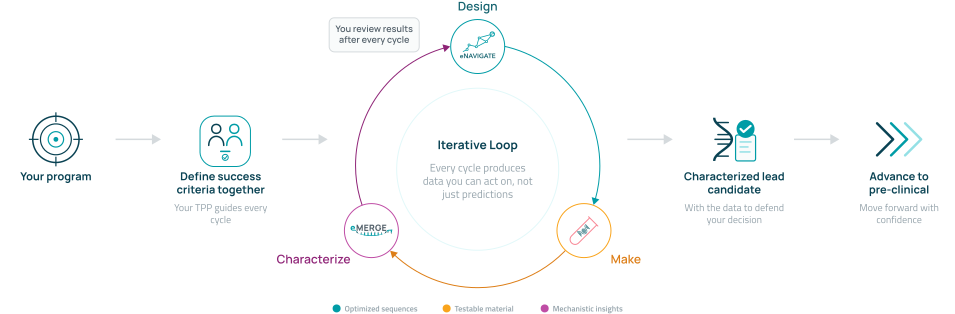
Fortunately, you can de-risk your drug development through integrated lab-in-the-loop platforms like Eclipsebio’s eCOMPASS. With lab-in-the-loop, you can combine AI-powered RNA design, rapid prototyping, and sequencing-based analytics to stay on top of potential roadblocks for your RNA therapeutic. Once you identify any issues, you can input this information back into the loop and improve your current RNA design to avoid these setbacks. Each cycle ends with a progressively better RNA candidate until yours is truly ready for the clinic.
In this eBlog, we will review some of the most common late-stage problems found in RNA therapeutics as well as how platforms like eCOMPASS can de-risk your RNA for efficient drug development.
dsRNA impurities
A common impurity with in vitro transcribed mRNAs is dsRNA. If this impurity is not removed, the dsRNA can trigger an innate immune response that decreases both the translation and half-life of the therapeutic
With eCOMPASS, you can catch dsRNA impurities before manufacturing scale up. Our RNA characterization platform eMERGE within eCOMPASS uses sequencing-based analytics to locate where dsRNA formation occurs at a single nucleotide level, revealing exactly where to make changes to the RNA design to reduce immunogenicity risk.
RNA fragmentation
Another common impurity is RNA fragments, arising from either the T7 polymerase falling off during synthesis or hydrolysis during storage. These fragments can trigger problematic cell responses and limit protein production but can be reduced through effective sequence design.
All eCOMPASS-designed sequences undergo extensive in silico analytics screening, including the identification of potential hydrolysis hotspots enabling the designs to be optimized for stability before manufacturing. Once synthesized, eSENSE Break provides nucleotide-level resolution into exactly where RNA is fragmented. When paired with RNA structure profiling (discussed below), these data improve the eNAVIGATE models, leading to more stable RNAs in the next round of design.
Structural liabilities
RNA candidates need well-designed secondary structures to be effective therapeutics. Secondary structure impacts the ratio of stability versus translatability of an RNA. If the structure is too loose with many exposed nucleotide bases, the RNA will have high rate of translation, but it will be unstable and degrade potentially before having the expected effect. If the structure is too rigid with few accessible nucleotides, the RNA will stay stable and last longer once delivered in a therapeutic, but it will have a lower rate of translation.
eCOMPASS can help you consider the risks of various secondary structures, guiding you to the best combination of stability and translatability for your therapeutic. As part of our standard analytics panel, we perform eSHAPE, a structure profiling technology, to reveal how different structures behave in varying conditions. The assay also identifies specific regions of RNA that impact stability that can be de-risked in further RNA design, as well as identifying structural features that contribute to dsRNA generation and RNA fragmentation. Data from this characterization is inputted back into the lab-in-the-loop, training AI models to balance stability, translation, and purity.
Translation bottlenecks
In order to have an effective therapeutic, you often need a smooth, high rate of translation from ribosomes. However, some characteristics of an RNA strand interrupt the ribosome’s ability to translate, causing ribosomes to pause, limiting protein production.
One source of ribosome pauses is due to rigid RNA secondary structure; the ribosome cannot move smoothly along the rigid structure, causing it to stall. Another cause of ribosome stalling is due to codon optimization. If rare codons are added to the design, the rate of translation slows as ribosomes wait for tRNAs to arrive. Finally, we have found that dsRNA impurities can also lead to pauses in ribosome translation either due to steric blocks from the dsRNA itself or the recruitment of dsRNA-recognizing factors.
In addition to decreasing the amount of protein production, ribosome stalls can also trigger cellular responses. To identify both ribosome stalls and therapeutic-induced changes in cell biology, eCOMPASS includes ribosome profiling as part of the standard analytics.
De-risk your RNA drug development
eCOMPASS helps you de-risk these issues and more in your RNA therapeutic candidate. With the platform’s integrated lab-in-the-loop, you can design an AI-optimized initial RNA candidate, prototype it in-house, and characterize it to identify any troublesome regions that could impact your therapeutic’s efficacy within weeks. Using that characterization data, you can repeat the process, further de-risking your RNA until it is ready to manufacture at a clinical scale with no surprises.
Interested in de-risking your RNA with eCOMPASS? Contact Eclipsebio today.
Latest eBlogs
RNA-targeting CRISPR: An innovative therapeutic tool
RNA-targeting CRISPR research has rapidly advanced in recent years, leading to several innovative mechanisms using CRISPR in RNA therapeutics.
Basecalling: A method to characterize multiple critical quality attributes
Basecalling directly determines what nucleotide bases are in an RNA sequence, revealing actionable characterization insights.